The short version. If a stranger texts you about a job that pays $100 to $600 a day for an hour or so of work, and tells you to text a different number, it is a scam. Do not reply. Block the number and forward the text to 7726.
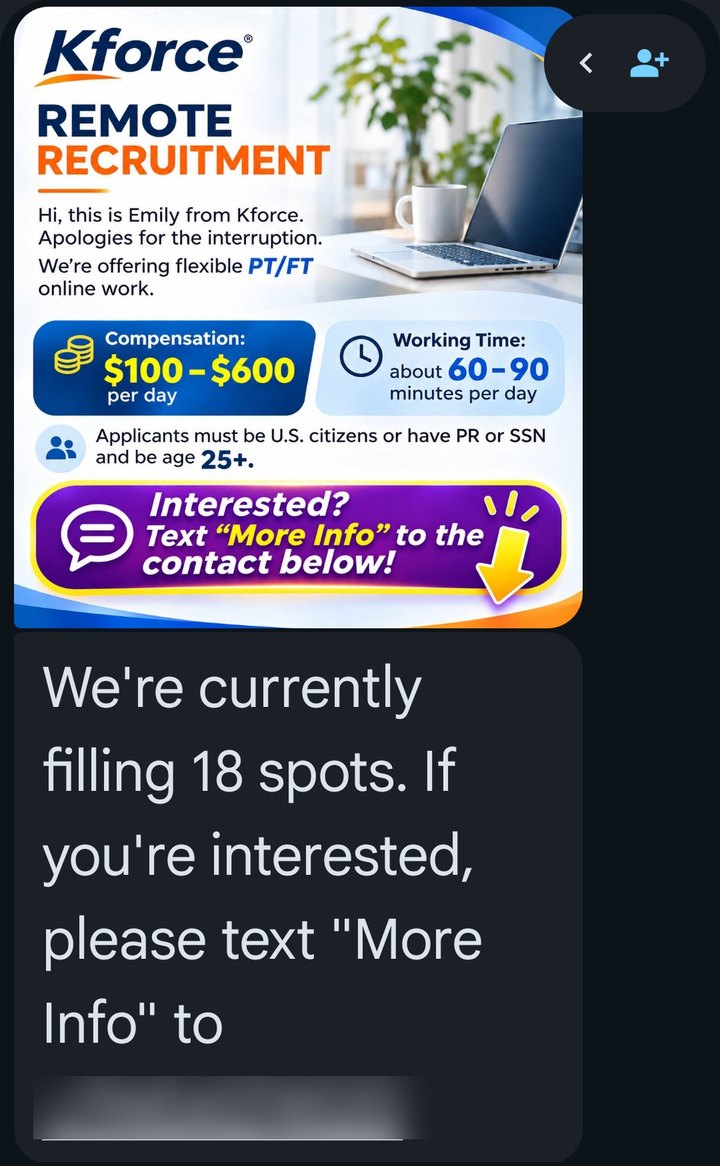
The text I got
It came from a phone number I did not know. It had a colorful flyer with the Kforce logo and a message from someone named "Emily." It said:
- Flexible part-time or full-time online work.
- Pay of $100 to $600 per day for about 60 to 90 minutes a day.
- Applicants must be U.S. citizens or have a green card or SSN, and be age 25 or older.
- "We're currently filling 18 spots."
- Text "More Info" to a different phone number.
I did not apply for anything, and I did not reply.
Kforce is a real company, and that is why this works
Kforce is a real staffing firm. Scammers borrow the names of real companies so a message looks believable. A real name on a flyer does not mean the message came from that company.
Six warning signs
- 1. It came out of nowhere. You did not apply, and it does not name a real job.
- 2. The pay is too high for the hours. $100 to $600 a day for an hour or so of work is not a real pay rate. The FTC has warned about texts offering remote jobs that pay up to $600 a day.
- 3. You are told to text a different number. My text came from one number and asked me to reply to another.
- 4. Age and citizenship rules appear in the text. Kforce says it does not state age ranges or U.S. citizenship requirements for its positions.
- 5. Pressure to act fast. "Filling 18 spots" is meant to make you hurry.
- 6. It leads toward your Social Security number. The FTC says scammers use texts like this to get a valid SSN, which can lead to identity theft.
How a real Kforce recruiter contacts you
Kforce posts a fraud alert on its own website. It says:
- Recruiters write from kforce.com email addresses. They will not contact you through Gmail or other email providers.
- They do not take applications or job offers through messaging apps such as WhatsApp, and they do not ask for government ID numbers or banking details there.
- They will not ask you to pay fees, buy gift cards, send money, or cash a check.
- They will not interview you through Telegram.
- They will not state age ranges or U.S. citizenship requirements for a position.
- They will not send you to a separate website to collect personal data before an offer is accepted. The one exception is a background check through a secure portal.
An honest note. Kforce's alert does not say anything about text messages in particular, so a text on its own does not prove a message is fake. This one fails the other tests: the pay, the different number, the age and citizenship rules and the lack of any real job.
What to do when you get one
- 1. Do not reply and do not tap any link. A reply tells the sender your number is active.
- 2. Block the number in your phone's Messages settings.
- 3. Forward the text to 7726 (it spells SPAM). This reports it to your phone carrier. Then delete it.
- 4. Check the company yourself. Go to its own website, not the contact information in the text. Search the company name with the word "scam" or "complaint." If you cannot find the company online, steer clear.
- 5. Report it at ReportFraud.ftc.gov.
If you already replied
- Do not share your Social Security number, your ID or your bank details.
- If you already shared personal information, go to IdentityTheft.gov to report it and get a recovery plan.
- If you gave out bank or card details, call your bank or card company right away.
- If someone is using Kforce's name, you can email Kforce at customersolutionscenter@kforce.com.
How to look for real remote work
- Start on the company's own careers page and apply there.
- Check that any recruiter emails come from the company's own domain.
- Read the posting. A real job names the role, the duties and the hours.
- Be careful with pay that sounds too good for the work. A real part-time job lists an hourly rate.
- Never pay to get a job, and never cash a check and send money back.
The rule I use
A real job does not text you out of the blue and ask you to text someone else. If it feels rushed, it is not real.
Sources
- Kforce, Fraud Alert: kforce.com/fraud-alert
- Federal Trade Commission, consumer alert on remote job text scams (August 2024): consumer.ftc.gov
- Report a scam: ReportFraud.ftc.gov · Identity theft help: IdentityTheft.gov
Want help with your business?
Talk through your next step with me, one on one.
Book a Business Tips SessionShared by Tyneil Allard. I teach and coach. I am not an attorney or a fraud investigator, and this is general information, not legal advice.